
Redox-Active Glycol Nucleic Acid (GNA) Components: Synthesis and Properties of the Ferrocenyl-GNA Nucleoside, Phosphoramidite, and Semicanonical Dinucleoside Phosphate
Streszczenie
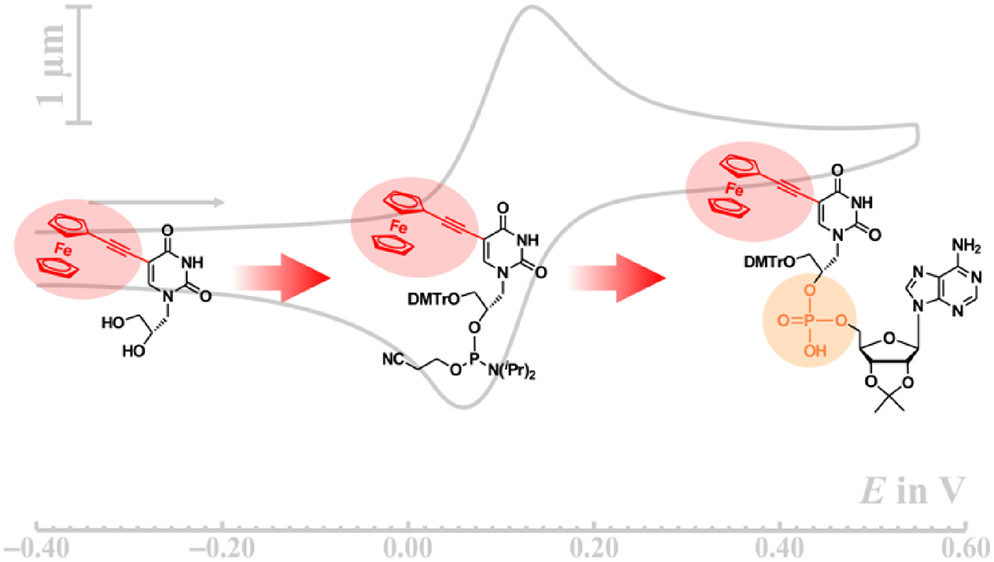
Ferrocenylated glycol nucleic acid (Fc-GNA) components are rarely studied in the field of xeno nucleic acid (XNA) chemistry. As an attempt to contribute to XNA chemistry, in the present article we report a seven-step synthesis of the first semicanonical dinucleoside containing the Fc-GNA nucleoside linked to the adenosine nucleoside with a phosphodiester bond. First, the nucleoside-bearing ethynylferrocenyl moiety in the C5 position of the uracil nucleobase was obtained. In the following steps, the nucleoside was transformed into the phosphoramidite intermediate that in turn was reacted with N6-benzoyl-2′,3′-O-isopropylideneadenosine to afford the target dinucleoside phosphate with 47% yield. The newly obtained Fc-GNA nucleoside is redox-active, and on the basis of this property (function), it belongs to a new class of functional GNA (fun-GNA) nucleosides. The electrochemistry of the Fc-GNA nucleoside, dinucleoside phosphate, and ferrocenyl furanopyrimidone nucleoside that was obtained as an undesired byproduct of Fc-GNA nucleoside synthesis was investigated by cyclic voltammetry (CV). The CV result showed the presence of a one-electron ferrocenyl-centered redox wave in each case. The half-wave potentials of the Fc-GNA nucleoside and dinucleoside phosphate were 89 and 99 mV, respectively, against the FcH/FcH+ couple. Finally, the activity of the newly obtained Fc-GNA components was studied against the nontumorigenic mouse L929 and human cervix adenocarcinoma HeLa cells. The synthesized compounds showed no cytotoxic activity against the tested cell lines.
Instytucja finansująca badania
K.K. thanks the National Science Center in Cracow, Poland (grant OPUS UMO-2018/29/B/ST5/00055), for financial support. Crystallographic measurements were carried out at the Biological and Chemical Research Centre, University of Warsaw, established within the project cofinanced by European Union from the European Regional Development Fund under the Operational Programme Innovative Economy, 2007–2013. The X-ray diffraction data were collected at the Core Facility for Crystallographic and Biophysical Research to support the development of medicinal products sponsored by the Foundation for Polish Science (FNP).Collections
Z tą pozycją powiązane są następujące pliki licencyjne:

Poza zaznaczonymi wyjątkami, licencja tej pozycji opisana jest jako Uznanie autorstwa 4.0 Międzynarodowe